CategoriesCoin Article

Athens Attica Silver Tetradrachm: Minted 449 – 413 BC

written by: James Obler

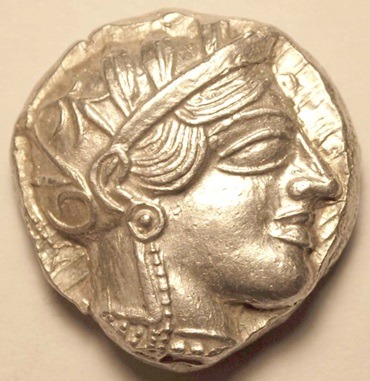
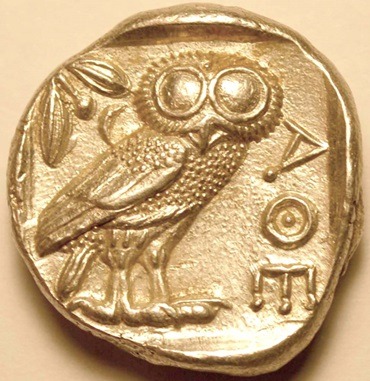
As you probably all know, we had a coin show in Fresno on October, 2020, organized by John Ward and supported by various members of FNS.  I picked up an exceptional coin at that show, from dealer Glen Schinke.  It is an Athens Attica silver tetradrachm from ancient Greece.  This coin is popularly known as an “owl” because of the owl figure that dominates the reverse side.  I have been aware of this coin ever since my parents picked up a brass replica piece at the New York Natural History Museum in about 1964.  It only took 56 years, but I finally have one to call my own.  Even though it’s over 2400 years old, it is extremely well-made and well-preserved.  Here are some photos of my new acquisition.

OBVERSE

REVERSE

The Owl is perhaps the most iconic and famous of all ancient coins.  It represented about 1 week’s pay for a soldier in ancient Greece and was minted in huge numbers in various forms, for several hundred years.  It is regarded as the first successful international coin, widely recognized and accepted throughout the ancient world.  The silver tetradrachm is widely believed to be the type of coin given to Judas for the betrayal of Jesus.  Legend has it that President Theodore Roosevelt carried an Owl coin and that it was in part the inspiration for Roosevelt’s interest in redesigning American coinage.

The Owl is pictured on the 1-euro coin of modern Greece and remains a symbol of the Greek city of Athens.  The images on both sides of the coin refer to the goddess Athena.  The obverse features the head of the goddess.  She wears an ornate earring and Attic-style military helmet adorned with olive leaves.  The reverse shows the Athenian owl which represents Athena.  The actual owl species depicted on the coins is believed to be the “little owl” (scientific name Athene noctua) which is native to the Mediterranean region.

The reverse legend reads AƟE (alpha-theta-epsilon).  This is an abbreviation which translates to “of the Athenians”.  There is a small crescent moon and an olive sprig with one berry.  According to mythology, Athena brought the olive tree to Athens as a gift, in order to impress Zeus and outshine rival god Poseidon. There are three general styles of Owls corresponding to different production dates.  The so-called Archaic type was first minted around 515 BC.  These are very scarce and expensive and despite their crude manufacturing quality are avidly sought by collectors.  The “Classical” Owls were produced in large quantities starting around 465 BC and continuing until the defeat of Athens by Sparta in 404 BC.  My coin is a classical-style piece with production date estimated between 449-413 BC by Glen Schinke.  Coins minted after 404 BC are called “Late Classical”, were struck on a smaller planchet, and are less popular with collectors.

Beginning around 165 BC “New Style” coins were issued.  These coins were struck on wider, thinner planchets and feature major changes to the reverse especially.  The owl image remains, but it now perches on an amphora and the fields include a grape bunch, an encircling laurel wreath, and text indicating the issuing magistrate.  The magistrate information allows more precise dating of these pieces.  Dating for the Archaic and Classical pieces is less certain.  Even major auction houses can disagree on dating for these earlier issues.

Owl silver is typically >99% pure.  Traces of copper and gold are present, in concentrations of less than 0.25% and 0.04%, respectively.  The silver ore was extracted from the Laurion mine complex located near Athens and was refined by smelting and cupellation processes which at the time were likely the most sophisticated in the world.  During many decades of operation, the estimated total production of silver from Laurion exceeded 3,000 tons.

It is believed that Owl planchets were prepared by pouring molten silver into molds that were sized to contain the proper amount of metal.  Target weight for a finished Owl was about 17.2 grams and most intact Owls in fact weigh between 17.0 and 17.2 grams.  The dies were likely made of bronze and were hand-engraved using burins, drills, chisels, and punches.  The obverse die was set into an anvil and the planchet placed on the die.  The reverse die was then positioned on the planchet and hand-struck with a heavy hammer. The reverse dies tended to wear out faster than the obverses.

Many Owls have test-cuts which were inflicted in ancient times to verify the coins were solid silver, not some plated base metal.  Others show countermarks punched in by merchants to confirm the coins were acceptable for commerce. No matter how you slice it, Owls are remarkable, historic, and beautiful coins.  I’m happy to finally have one in my collection.

CategoriesCoin Article

A Brief Discussion on Commemorative Coins

written by James Obler

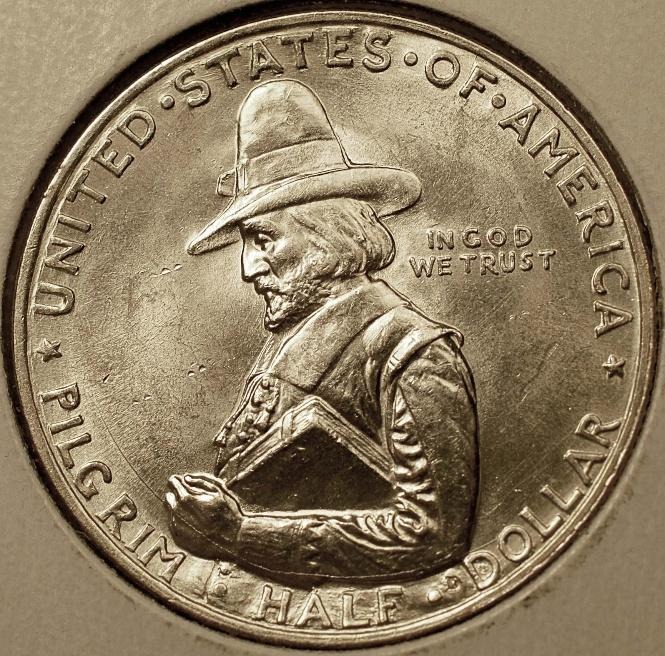
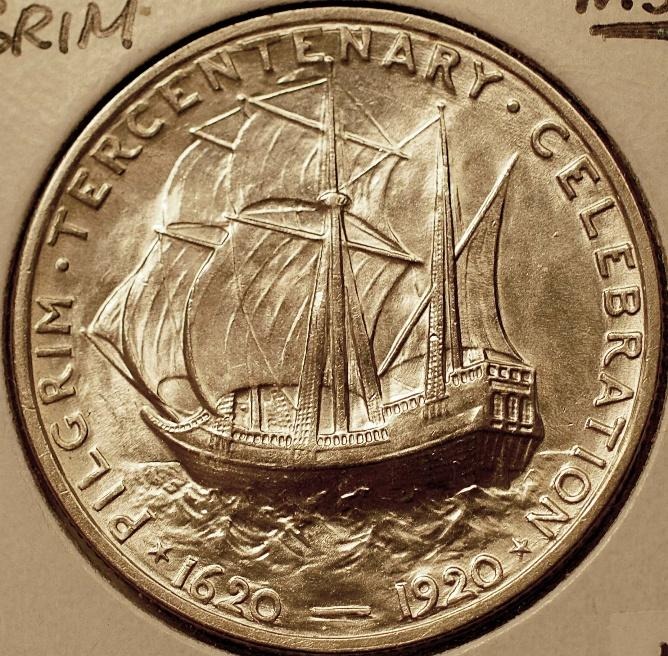
I usually buy raffle tickets at our monthly FNS raffle, both to benefit the club and to possibly win a prize.  One month I got lucky and came away with the big win, a 1920 commemorative Pilgrim half dollar in nice BU grade.  This coin was issued in 1920 and 1921 to mark the 300th anniversary of the Pilgrims’ arrival in North America and their founding of the Plymouth Colony.  The obverse of this coin features a portrait of William Bradford, who led the Colony for 30 years.  The portrait is an artistic guess since no authentic painting or image of Bradford is known.  The figure holds a Bible in recognition of the religious focus of the Pilgrim expedition.  The reverse shows the ship Mayflower under full sail.  This coin was struck in high relief and is really quite elegant.  Here are photos of that coin.

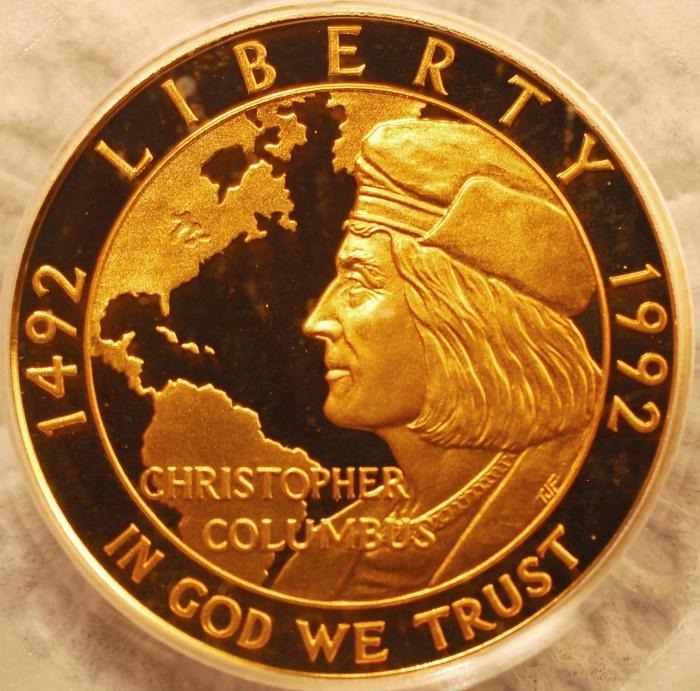
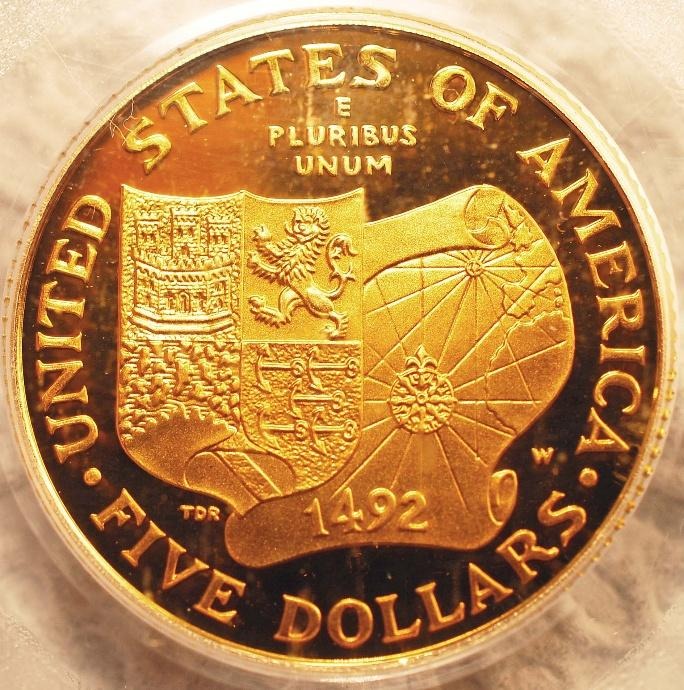
I have two other commemorative coins:  an 1893 Columbian half dollar, and a 1992 Columbian 5-dollar gold piece.  These coins were struck to honor the 400th and 500th anniversaries, respectively, of the landing of Christopher Columbus and his expedition in the New World.  Both these coins feature creative designs which highlight the achievement of Columbus as an explorer.  Here are photos of the gold coin.

So, what is the point of American commemorative coins?  It seems obvious:  to publicly recognize significant events and people that were important in the history of the United States, and to preserve the memory of those events for the benefit of future Americans.  A quick look at the commem section of the Guide Book of United States Coins (Red Book) provides a virtual bullet point list of important events and pivotal historical figures.

Crucial battles from the American Revolution and the Civil War have been memorialized with commemorative coins.  The Louisiana Purchase and the Lewis and Clark Expedition are celebrated with gold dollar coins.  The opening of the Panama Canal is recognized with a silver half dollar and gold dollar and quarter-eagle coins, plus the remarkable gold 50-dollar pieces, struck on both round and octagonal planchets.  

The silver half dollar is the most common format of commemorative, often used to mark important anniversaries of the founding of states, territories, and cities.  Both a half dollar and a gold quarter eagle ($2.50 face value) were issued in 1926 to celebrate the sesquicentennial (150th anniversary) of the Declaration of Independence.  Half dollars commemorate major expositions in San Diego, CA and Cleveland, OH, as well as the opening of the Oakland-San Francisco Bay Bridge.  Famous people from American history are well represented on commemorative coins:  George Washington, Abraham Lincoln, the Marquis de Lafayette, Daniel Boone, Booker T. Washington, and George Washington Carver all appear on various issues.  Even the notorious P.T. Barnum has a place on a U.S. silver half dollar!

Many commemorative coin programs were operated as fund-raising efforts, to help pay for the construction of memorials, for example.  Once the program organizers were granted authority to design the coins, they were struck by the US Mint and sold to the public at a premium over face value.  In some cases, unsold coins were released into circulation.  Collectors who diligently hunt through coin rolls occasionally report the discovery of commemoratives such as the 1923 Monroe Doctrine Centennial and 1925 Stone Mountain Memorial silver half dollars.

The so-called Classic period of US commems ran from 1892 to 1954.  The Modern commem era commenced in 1982 with the issue of a 90% silver half dollar marking the 250th anniversary of the birth of George Washington.  Silver dollars and gold $10 coins were issued in 1983 and 1984 to mark the Los Angeles Olympics.  New commem issues have followed on a regular basis, in silver dollar, gold $5, and clad half dollar denominations.  The 2000 Library of Congress commem $10 coin features a unique bimetallic planchet made of gold and platinum.  There are dozens of modern issues, with more hitting the market every year.  It takes a really dedicated (perhaps fanatical!) collector to assemble a complete set.

A major factor in the appeal of commemorative coins is their tangible connection with American history.  In an era when some Americans appear to be ashamed of our national history, we have these commemorative coins to remind us about what many more Americans believe is important.  I look at my Pilgrim half dollar and think, “hey, in 1920 people knew that the arrival of the Pilgrims in 1620 was a big deal.”  Even if you aren’t a big fan of the Pilgrims, their arrival and settlement in Massachusetts was a formative event for our national story.  Now, when we are entering the second quarter of the 21st Century, various critics of America and of United States policies like to single out aspects of our country which they dislike and claim, “that’s not who we are”.  Well, our commemorative coinage offers a contrary opinion.  The events and people honored on these coins received that honor precisely because they represent who Americans really are.

CategoriesCoin Article

A Collector’s Guide to Proof Coins

written by James Obler

Proof coins offer an important option for numismatists.  Proofs are special versions of regular circulating coins that are manufactured for sale to collectors.  Precious metal bullion coins and commemorative coins are also frequently struck in proof format.  Modern proofs typically have deeply mirrored, highly reflective fields and frosty white devices (portraits, dates, images, and legends).  Many countries produce proof coinage;  some nations have been cranking them out since the 1800s, or even longer.  In the United States, proofs are struck from specially-made polished planchets and the dies are treated to generate the desired mirror fields and frosted features.  Proofs are generally struck using two cycles of the coin press, to ensure all design elements have maximum detail and surface quality.  The resulting coins represent “state of the art” in coin production.  In recent years the US Mint has offered variations on their traditional proof format, such as “reverse proofs” which have frosted fields and brilliantly shiny and reflective devices.

Although various “specimen” coins have been produced at the Philadelphia mint from its earliest years, the first no-question proof US coins were made around 1817.  The earliest example I could find on the Heritage website (www.ha.com) was an 1818 quarter, graded NGC Proof-67.  This amazing coin sold at auction in 2019 for $288,000.  The first copper and gold US proof coins also appeared around this time.  Proof mintages during these early years were extremely small and surviving examples are few and far between.

Coin collecting in the US became much more popular around 1857 when large cent and half cent production was discontinued.  The Philadelphia mint began producing annual sets of proof coins for sale to the general public starting in 1858.  Clients could purchase minor coin sets (cents, two and three cent pieces, and nickels), silver sets including half dimes through silver dollars, and complete sets with gold denominations.  Some proof coins could also be ordered individually.  Mintage numbers were in the hundreds for most silver proofs and up to a few thousand for minor coins.  For most gold proof issues only a couple dozen pieces were generally made.  Classic gold proof coins from the 1800s and early 1900s have been called the caviar of numismatics, to reflect their great rarity and value.

Proof examples of each denomination (including gold coins) continued to be minted through 1915.  Production was discontinued until 1936 when new 5-coin sets were produced.  Proof coinage again took a break after 1942, resuming in 1950.  One final break happened from 1965-1967;  from 1968 on proof sets have been made every year.

Modern proof sets are plentiful.  Most sets containing clad coins had mintage numbers in the millions and are often available to collectors at a cost lower than the original issue price.  Modern silver proof sets have been made since 1992 and include dimes, quarters, and half dollars struck in 90% silver.  These sets are priced according to their silver content;  their cost went way up in early 2026 due to the huge increase in the spot price of silver.  Modern proof coins are beautiful and so perfectly made that many qualify for the ultimate Proof-70 grade at major grading services.  If you want super quality coins at a small price these sets will do the trick.  They are especially nice as gifts for novice collectors.  FNS typically purchases several dozen modern sets to be used as prizes in our Coin Safari activity for Young Numismatists, at our annual coin show. 

Classic proof coins issued before 1916 can be surprisingly available.  These proof coins were (obviously) made for collectors who typically took good care of them.  Many of the coins produced and sold have survived in high grade.  The (relatively) large population of available pieces means prices can be somewhat affordable, in some cases significantly lower than the cost of comparable mint state (business strike) pieces from the same years.  If you are looking for beautiful examples of classic type coins it can make sense to go for proof coins.

As of June, 2026 it is possible to buy some classic proof coins at what might be considered affordable prices.  A quick look at fixed-price listings from a major online dealer spots some potential bargains.  How about a beautifully toned 1899 Indian Cent graded Proof-65 red-brown, for $750?  An 1882 Three-cent Nickel in PCGS PR-66 will set you back $715.  An 1881 Shield nickel in NGC PR-66 is currently priced at $850.   An 1883 Seated Liberty silver dime in PCGS PR-63 can be yours for just $675.  These prices aren’t exactly cheap, but considering these are extremely high-quality collector coins well over 100 years old, they will appeal to many collectors.

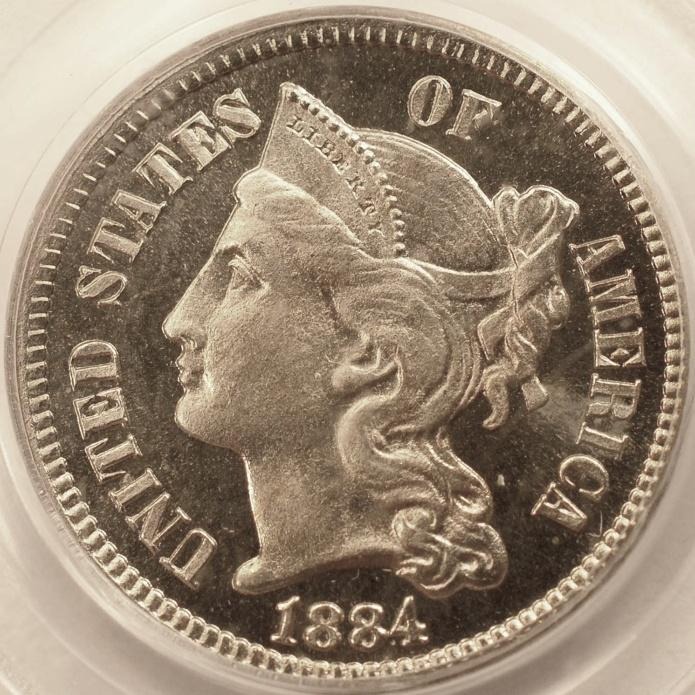
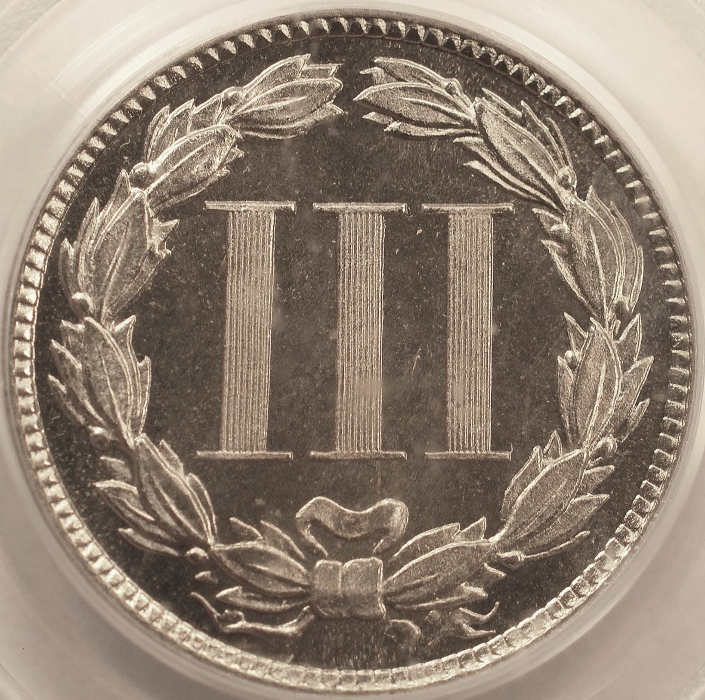
Here is an example of classic proof coinage.  This is a three-cent nickel coin from 1884.  The devices all show white mint frost while the fields have clear mirrored surfaces.  The contrast between the dark-appearing fields and the white devices produces an effect called Cameo.  In general, the greater the contrast between fields and devices, the greater the eye appeal and potential value for a buyer.  This particular coin is graded PR-65 by PCGS.

In many cases a classic proof will give you a thrilling combination of beauty, quality, and that special “cool factor” that makes the piece irresistible.  Sometimes they can even save you money compared to a business strike example of the same date and type.  These are terrific coins that would grace any collection and are within reach of many collectors.  If you prefer high quality at a much lower price, modern proofs will fit into any collecting budget.  So, next time you are in the mood for some truly beautiful coins, take a look at the proofs!

CategoriesCoin Article

A Brief Discussion About Replica Coins

written by James Obler

Replica coins are privately-made copies of genuine coins.  They are usually made not to be spent as counterfeit money, but rather to substitute for collectible coins in a collection.  They are commonly encountered by coin collectors and it is important for collectors to be able to recognize them and distinguish them from genuine coins.  The grading service industry was established in part to provide expert authentication to certify that a valuable coin is in fact a legitimate example.

There is nothing inherently evil about a replica coin.  There is a place for replicas in numismatics, particularly in cases where a genuine piece is rare and expensive.  A well-made replica can be a pleasing acquisition and may satisfy the collector who wants to “fill that hole” in their collection, without taking out a second mortgage.  The danger is when the seller represents the replica as a genuine coin and attempts to defraud the buyer.

The biggest source of deceptive replicas is probably China.  There are no real legal barriers in China to prevent manufacture of what are straight-up counterfeit coins.  Almost every type of collectible US coin has been “made in China” and many of these enter the collecting market.  Some of these fakes are quite crude while others are extremely deceptive, matching the original designs quite closely and even being composed of the same metal alloys as original pieces.  Some issues like US Trade dollars, Seated Liberty dollars, and three-dollar gold pieces are notorious for being counterfeited.  Such “coins” have often appeared in online sales venues like eBay and others.  Some sellers are ignorant of the counterfeit nature of the lots, while others are fully aware and are actively trying to defraud a buyer.  You sometimes see listings of an obvious counterfeit, with a description like “found in Grandpa’s safe” or “handed down by a relative.”  Such comments are usually weak attempts to hide a fraudulent origin.  EBay to its credit does try to exclude counterfeit coin listings and will delete them if detected.

There are legitimate replica coins that are made and sold ethically.  The Hobby Protection Act of 1973 made provisions for the legal production and sale of imitation or replica numismatic items.  Specifically, replica coins can be made but they must be prominently engraved with the word “COPY.”  A company named The Gallery Mint made high-quality replicas of such rarities as the 1796 Quarter, the 1793 Wreath Cent, and the 1796 Quarter Eagle.  These pieces were made using (respectively) the silver, copper, and gold alloys used for the original coins and an authentic screw press was employed to do the actual striking.  The “Copy” stamp was applied to obverse or reverse, as preferred by the customer.  The Gallery Mint is no longer in business but their products still appear on the market.

A currently-operating company called The Moonlight Mint is the brainchild of engraver and sculptor Daniel Carr.  Moonlight Mint has made “fantasy” coins including near-perfect replicas of genuine US designs.  Moonlight Mint avoids the restrictions of the Hobby Protection Act by making pieces with dates that were never used for actual circulating coins.  Since these products do not replicate “real” coins they do not need to carry the COPY engraving.  One example is the 1964-D Peace Dollar, which was actually made at the Denver Mint in 1964 but was never issued and all examples were destroyed.  Daniel Carr recreated these pieces and struck them on actual US silver dollars so the weight and silver content would be exactly correct.  The limited-edition run of this piece rapidly sold out and examples currently are resold legally and at a very steep price.

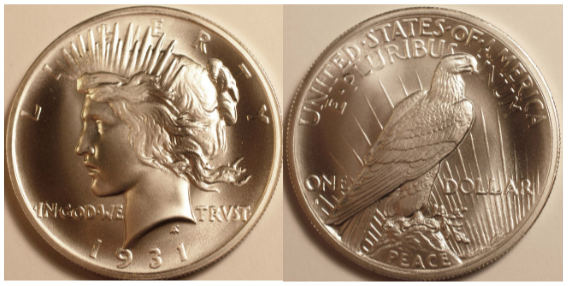
Another Moonlight Mint product is a Peace dollar dated 1931-S.  Since no genuine Peace dollars were minted in 1931 it was not illegal to produce and sell this fantasy issue.  Genuine US silver dollars were used as the planchets and these 1931-S pieces were struck in high relief like the original 1921 Peace dollar.  Even though this is not a genuine US Mint product, it is a beautiful piece that might appeal to any collector, especially one who appreciates Peace dollars.  Here are images of this fantasy coin.

In summary, replica coins are legitimate collectibles, as long as the distinction between replica and authentic pieces is clear.  Collectors must be aware that authenticity for collectible coins is always a concern.  Any potential purchase should be examined closely until the buyer is satisfied it is a genuine piece.  You can help ensure you are getting a genuine coin if you buy a certified example, especially if the coin is particularly valuable or is a type that is commonly counterfeited.  Enjoy your collection, but, as always, buyer beware!  

CategoriesCoin Article

History and Coinage Operations of the New Orleans Mint

written by James Obler

The New Orleans Mint in Louisiana operated from 1838 through 1861, and again from 1879 through 1909.  Coins minted in New Orleans bear the distinctive “O” mintmark and are an important focus for numismatists.  The history of the mint and details about its operations are fascinating subjects for study.  This article explores this topic and offers some specific information about the manufacturing processes employed during the mint’s years of coin production.

President Andrew Jackson was a military hero based on his decisive victory over British forces at the Battle of New Orleans, at the tail end of the War of 1812.  During his presidency he was a proponent of creating branch mints to increase the production of United States coinage.  On March 3, 1835 Jackson signed a bill authorizing the construction of three new mints, to be located at Dahlonega, Georgia, Charlotte, North Carolina, and New Orleans, Louisiana.  The Dahlonega and Charlotte mints were relatively small facilities and produced gold coins only.  Both of those mints closed at the onset of the Civil War and never reopened.  The much larger New Orleans mint produced gold and silver coins, in all denominations.  Although this facility also closed during the Civil War it reopened in 1879 and continued to manufacture gold and silver coins until 1909.

 Historical records include many contemporary references that describe in detail the production processes employed at the New Orleans Mint.  From the acquisition of the gold and silver raw material to the eventual shipment of the finished coins, the entire minting operation is a fascinating area of study.  The New Orleans mint operated in an era when coal-fired steam engines powered the equipment, horse-drawn wagons were a primary means of transportation, and electricity and the internal combustion engine were just coming into widespread use.  The Mint nevertheless developed machines and procedures that allowed the efficient production of coins on a tremendous scale.

The New Orleans mint typically received precious metal in the form of dust, ingots, foreign coins, and old jewelry.  The depositor was given a receipt and charged a fee if refining was needed to prepare the metal for coinage.  The metal was assayed and the result reported to the mint treasurer.  Once the value of the metal was determined the depositor presented his receipt and was paid in US currency.

The refined, alloyed metal was melted and cast into standard-sized ingots which were repeatedly passed through a rolling mill to create metal strip of the proper thickness.  The strips were heated and cooled (a process called annealing) as needed to keep the metal malleable.  The final thickness adjustment was made at a “drawing bench” where the strips were drawn between precisely calibrated steel cylinders.  A vertical steel punch apparatus was then used to cut out the circular coin planchets.  Each punch at maximum operating speed could turn out 225 planchets per minute.  The strip scrap remaining after planchets were punched out was returned to the furnace for re-melting.  In fact, all gold and silver scrap was carefully monitored and controlled, with very little loss.

Female employees were generally hired to sort the planchets to ensure the weights were correct.  Light planchets were returned for re-melting while heavy ones were hand-filed to correct the weights.  Approved planchets proceeded to the milling room, where they were compressed between a rotating steel wheel and a stationary wall;  this created a uniform raised rim on each planchet.  Depending on denomination, between 500 and 1200 planchets could be milled per minute.  Finished planchets were annealed, washed, and sent to the coining room.

Different coining presses were employed for different coin denominations.  Planchets were fed into brass tubes from which they were removed and placed in the coining chamber by steel feeder fingers.  The dies closed on the planchet with a force of around 150 tons of pressure to create each coin.  The feeders simultaneously grasped the finished coin and the next planchet;  the feeder motion then transferred the coin into a collection hamper and placed the planchet into the coining chamber.  The rate of coin production was generally about 85 coins per minute, per press.

Finished coins were inspected, weighed, and packaged in boxes.  The filled boxes were weighed in the presence of the treasurer.  If the weight was correct, the sealed box was placed in a vault.  Samples corresponding to each potential shipment were sent to the assay department at the Philadelphia mint for review.  If approved, each shipment was made available for coinage orders.  If samples were rejected, the affected production run was condemned and re-melted.

During its years of operation (from 1838 to 1861 and from 1879 to 1909) the New Orleans mint produced silver 3-cent pieces, half dimes, dimes, quarters, half dollars, and dollars.  With the exception of the 4-dollar Stella patterns, New Orleans produced gold coins in all denominations:  gold dollars, quarter eagles, three-dollar gold pieces, half eagles, eagles, and double eagles.  The gold and silver coins from New Orleans include many rare and valuable issues.  Among these are the extremely rare 1838-O proof half dollars, the 1856-O gold double eagle, and the unique proof 1844-O eagle and half eagle coins.  However, many more issues are common and easily within reach for the average collector.  The coinage of New Orleans is an important and popular focus for numismatists.  Every collector of United States coins should own at least one example struck at the legendary New Orleans mint. 

CategoriesCoin Article

The True (?) Story of the 1792 Half Disme

written by James Obler

Prominent coin dealer and former ANA President Jeff Garrett wrote an interesting article about the 1792 Half Disme which was posted on the NGC website on 06/18/2020.  The article discussed the history of this special coin and reported on some new research that casts new light on its probable origin story.  This research has uncovered clear evidence that these coins were struck for general circulation and, unlike other denomination coins struck in 1792, were not patterns.  Accordingly, the newest edition of the Red Book (as of 2020) lists this coin in the regular-issue Half Dime section.  Incidentally, the word disme is an obsolete French word meaning “a tenth part”.  It is pronounced “deem”.

It is generally agreed that an attempt to develop a national coinage was made in 1792.  1,500 silver half dismes were coined by U.S. Mint employees in the basement of saw maker John Harper’s Philadelphia factory.  There are two commonly-reported legends associated with this important event.  The first is that George Washington provided his own silverware to be melted down for the production of the coins.  The second is that Martha Washington was the model for the portrait used on the coins.   Recent research as related by Mr. Garrett tells a somewhat different story.

Thomas Jefferson maintained a personal ledger of income and expenses which he called his Memorandum Book.  An entry dated July 11, 1792 reads “Delivd. 75.D at the mint to be coined” and on July 13 another entry reads “Rec’d from the mint 1500. half dismes of the new coinage”.  75 Spanish milled dollars (75.D) contain the exact amount of silver needed to make 1500 half dismes.  That same day (July 13, 1792) Jefferson left Philadelphia to begin his summer vacation at Monticello.  His Memorandum Book records that he made numerous expenditures of 5 cents or multiples of that amount on his trip.  This information constitutes strong evidence that not only was Thomas Jefferson directly involved in the production of the 1792 half dismes, he also regarded them as circulating coinage and personally used them as such.  

Another indicator of the regular-coinage status of the half disme is found in President Washington’s fourth annual message to Congress on November 6, 1792, in which Washington specifically stated that the half dismes had been made as regular coinage.  One additional relevant piece of information is that a unique example of the half disme is known that was struck in pure copper.  The existence of this piece suggests the dies were first tested using a base metal planchet, after which the production run was completed using Jefferson’s silver.  The copper example then would be the actual pattern half disme coin.

Many examples of  1792 half dismes are known in various circulated grades.  Some pieces are holed and presumably were worn as jewelry.  A few gems are known and these are among the most desirable coins in all of numismatics.   The current price record (as of 2020) is held by the finest known example, graded NGC MS-68.  This spectacular toned beauty is pedigreed to David Rittenhouse, the first director of the US Mint.  It was sold in 2018 by Classic Coin Company for $1,985,000.  That’s only 39.7 million times face value!  Here are images of this amazing coin.

Now that the true history of the half disme is known, demand for these iconic American treasures might become even more intense.  It seems likely that new record prices may be set in the future.

CategoriesCoin Article

Silver Content Analysis for Selected Ancient Coins

The first silver coins were produced around 600 BC in various locations including Lydia (in present-day Turkey) and India. The Greeks began striking silver coins before 500 BC and were likely the most prolific silver coin producers of their time. Silver coin production continued with the Romans and with practically every other empire, kingdom, and country for the following two thousand years. It’s only in the modern age that circulating silver coinage has been discontinued. While silver is obviously still a precious metal, it is no longer used to make coins for commerce.

CategoriesCoin Article

Error Coins

Often errors occur during the coin manufacturing process. Depending on the nature of the error, the resulting abnormal coin may have no significant extra value, it may carry a slight to moderate value premium to an error specialist, or it may be very valuable. This article shows examples of several types of error coins.

CategoriesCoin Article

The Silver “Owl” of Ancient Greece

The Fresno Numismatic Society hosted our annual Coin Show on October 23 and 24, 2020.  As usual, we had an excellent group of dealers who offered a great variety of coins and currency.  I spotted an exceptional coin in the display case of dealer Glen Schinke.  It is an Athens Attica silver tetradrachm from ancient Greece.  This coin is popularly known as an “owl” because of the owl figure that dominates the reverse side.  I have been aware of this coin ever since my parents picked up a brass replica piece at the New York Natural History Museum in about 1964.  It only took 56 years, but I finally have one to call my own.  Even though it’s over 2400 years old, it is extremely well-made and well-preserved.  Here are some photos of this wonderful coin.