Prominent coin dealer and former ANA President Jeff Garrett wrote an interesting article about the 1792 Half Disme which was posted on the NGC website on 06/18/2020. The article discussed the history of this special coin and reported on some new research that casts new light on its probable origin story. This research has uncovered clear evidence that these coins were struck for general circulation and, unlike other denomination coins struck in 1792, were not patterns. Accordingly, the newest edition of the Red Book (as of 2020) lists this coin in the regular-issue Half Dime section. Incidentally, the word disme is an obsolete French word meaning “a tenth part”. It is pronounced “deem”.
It is generally agreed that an attempt to develop a national coinage was made in 1792. 1,500 silver half dismes were coined by U.S. Mint employees in the basement of saw maker John Harper’s Philadelphia factory. There are two commonly-reported legends associated with this important event. The first is that George Washington provided his own silverware to be melted down for the production of the coins. The second is that Martha Washington was the model for the portrait used on the coins. Recent research as related by Mr. Garrett tells a somewhat different story.
Thomas Jefferson maintained a personal ledger of income and expenses which he called his Memorandum Book. An entry dated July 11, 1792 reads “Delivd. 75.D at the mint to be coined” and on July 13 another entry reads “Rec’d from the mint 1500. half dismes of the new coinage”. 75 Spanish milled dollars (75.D) contain the exact amount of silver needed to make 1500 half dismes. That same day (July 13, 1792) Jefferson left Philadelphia to begin his summer vacation at Monticello. His Memorandum Book records that he made numerous expenditures of 5 cents or multiples of that amount on his trip. This information constitutes strong evidence that not only was Thomas Jefferson directly involved in the production of the 1792 half dismes, he also regarded them as circulating coinage and personally used them as such.
Another indicator of the regular-coinage status of the half disme is found in President Washington’s fourth annual message to Congress on November 6, 1792, in which Washington specifically stated that the half dismes had been made as regular coinage. One additional relevant piece of information is that a unique example of the half disme is known that was struck in pure copper. The existence of this piece suggests the dies were first tested using a base metal planchet, after which the production run was completed using Jefferson’s silver. The copper example then would be the actual pattern half disme coin.
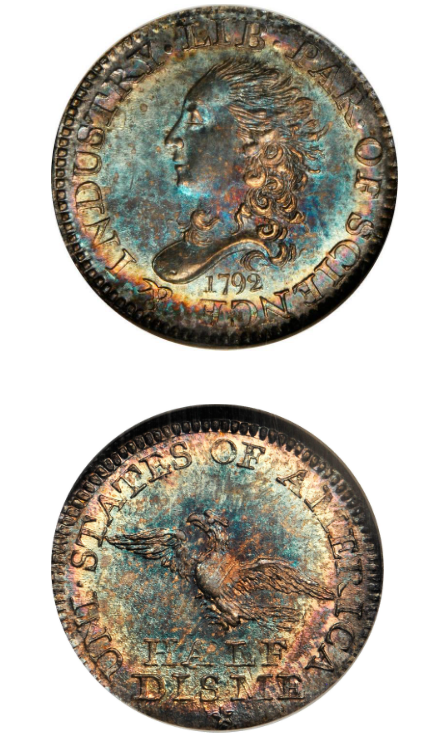
Many examples of 1792 half dismes are known in various circulated grades. Some pieces are holed and presumably were worn as jewelry. A few gems are known and these are among the most desirable coins in all of numismatics. The current price record (as of 2020) is held by the finest known example, graded NGC MS-68. This spectacular toned beauty is pedigreed to David Rittenhouse, the first director of the US Mint. It was sold in 2018 by Classic Coin Company for $1,985,000. That’s only 39.7 million times face value! Here are images of this amazing coin.
Now that the true history of the half disme is known, demand for these iconic American treasures might become even more intense. It seems likely that new record prices may be set in the future.