Replica coins are privately-made copies of genuine coins. They are usually made not to be spent as counterfeit money, but rather to substitute for collectible coins in a collection. They are commonly encountered by coin collectors and it is important for collectors to be able to recognize them and distinguish them from genuine coins. The grading service industry was established in part to provide expert authentication to certify that a valuable coin is in fact a legitimate example.
There is nothing inherently evil about a replica coin. There is a place for replicas in numismatics, particularly in cases where a genuine piece is rare and expensive. A well-made replica can be a pleasing acquisition and may satisfy the collector who wants to “fill that hole” in their collection, without taking out a second mortgage. The danger is when the seller represents the replica as a genuine coin and attempts to defraud the buyer.
The biggest source of deceptive replicas is probably China. There are no real legal barriers in China to prevent manufacture of what are straight-up counterfeit coins. Almost every type of collectible US coin has been “made in China” and many of these enter the collecting market. Some of these fakes are quite crude while others are extremely deceptive, matching the original designs quite closely and even being composed of the same metal alloys as original pieces. Some issues like US Trade dollars, Seated Liberty dollars, and three-dollar gold pieces are notorious for being counterfeited. Such “coins” have often appeared in online sales venues like eBay and others. Some sellers are ignorant of the counterfeit nature of the lots, while others are fully aware and are actively trying to defraud a buyer. You sometimes see listings of an obvious counterfeit, with a description like “found in Grandpa’s safe” or “handed down by a relative.” Such comments are usually weak attempts to hide a fraudulent origin. EBay to its credit does try to exclude counterfeit coin listings and will delete them if detected.
There are legitimate replica coins that are made and sold ethically. The Hobby Protection Act of 1973 made provisions for the legal production and sale of imitation or replica numismatic items. Specifically, replica coins can be made but they must be prominently engraved with the word “COPY.” A company named The Gallery Mint made high-quality replicas of such rarities as the 1796 Quarter, the 1793 Wreath Cent, and the 1796 Quarter Eagle. These pieces were made using (respectively) the silver, copper, and gold alloys used for the original coins and an authentic screw press was employed to do the actual striking. The “Copy” stamp was applied to obverse or reverse, as preferred by the customer. The Gallery Mint is no longer in business but their products still appear on the market.
A currently-operating company called The Moonlight Mint is the brainchild of engraver and sculptor Daniel Carr. Moonlight Mint has made “fantasy” coins including near-perfect replicas of genuine US designs. Moonlight Mint avoids the restrictions of the Hobby Protection Act by making pieces with dates that were never used for actual circulating coins. Since these products do not replicate “real” coins they do not need to carry the COPY engraving. One example is the 1964-D Peace Dollar, which was actually made at the Denver Mint in 1964 but was never issued and all examples were destroyed. Daniel Carr recreated these pieces and struck them on actual US silver dollars so the weight and silver content would be exactly correct. The limited-edition run of this piece rapidly sold out and examples currently are resold legally and at a very steep price.
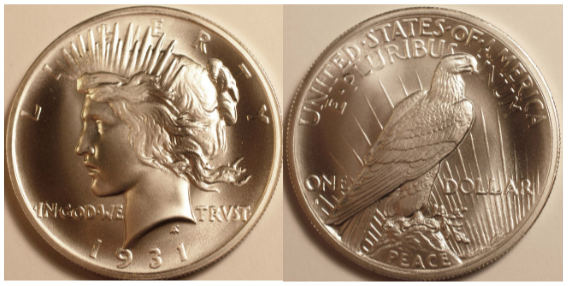
Another Moonlight Mint product is a Peace dollar dated 1931-S. Since no genuine Peace dollars were minted in 1931 it was not illegal to produce and sell this fantasy issue. Genuine US silver dollars were used as the planchets and these 1931-S pieces were struck in high relief like the original 1921 Peace dollar. Even though this is not a genuine US Mint product, it is a beautiful piece that might appeal to any collector, especially one who appreciates Peace dollars. Here are images of this fantasy coin.
In summary, replica coins are legitimate collectibles, as long as the distinction between replica and authentic pieces is clear. Collectors must be aware that authenticity for collectible coins is always a concern. Any potential purchase should be examined closely until the buyer is satisfied it is a genuine piece. You can help ensure you are getting a genuine coin if you buy a certified example, especially if the coin is particularly valuable or is a type that is commonly counterfeited. Enjoy your collection, but, as always, buyer beware!