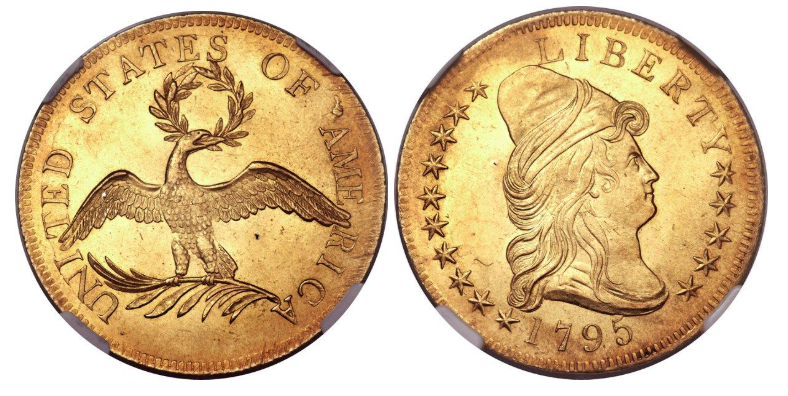
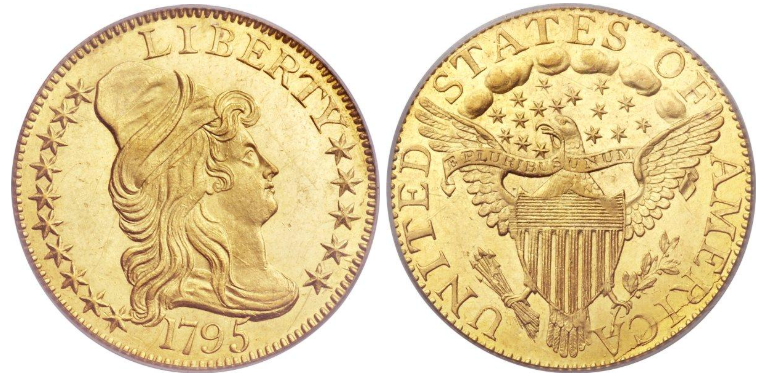
The five-dollar gold piece, or half eagle, is the first gold coin to be struck for the United States. The denomination was authorized by the Act of April 2, 1792. The weight was assigned at 135 grains (8.748 grams) and the fineness was 0.8992 (89.92% pure gold). That translates to a net gold content of 7.866 grams, or 0.2529 troy ounces. The first year of issue was 1795 and the design featured a right-facing bust of the goddess Liberty wearing a Phrygian cap. This cap was worn in Asia Minor (present-day Turkey) as early as 800 B.C. and was seen as the mark of free men in ancient Greece. Based on the Phrygian cap’s resemblance to a turban, some writers have referred to these coins as the Turban Head design. The reverse featured a “small” eagle holding a wreath in its beak. This design was minted from 1795 to 1798. The small eagle was replaced by a larger, heraldic eagle with shield for coins dated 1798 through 1807. Some coins with heraldic eagles exist with 1795 and 1797 dates but these were probably minted in 1798. Here are some images of these two Half Eagle types, borrowed from the Heritage auction website (ha.com).
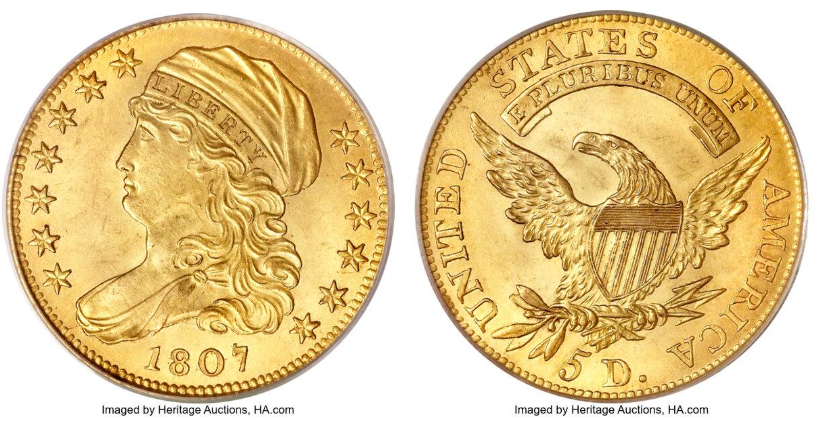
The design changed again in 1807, with the Liberty bust now facing left and the eagle replaced by a smaller version, still with a shield on its breast. For the first time, the denomination (5 D.) appeared on the coin and the motto E Pluribus Unum was placed over the eagle. The next change came in 1813, when the capped bust figure was replaced with the so-called “capped head to left”; the reverse was not significantly changed. Use of a “close collar” on the coin press was implemented in 1829, which resulted in a slightly smaller coin diameter. The design was continued until 1834. The capped head half eagle series includes some great rarities, with surviving populations of less than a dozen. The most famous (but NOT the rarest) is the 1822, with just three examples known. Here are images of Capped Bust and Capped Head coins.
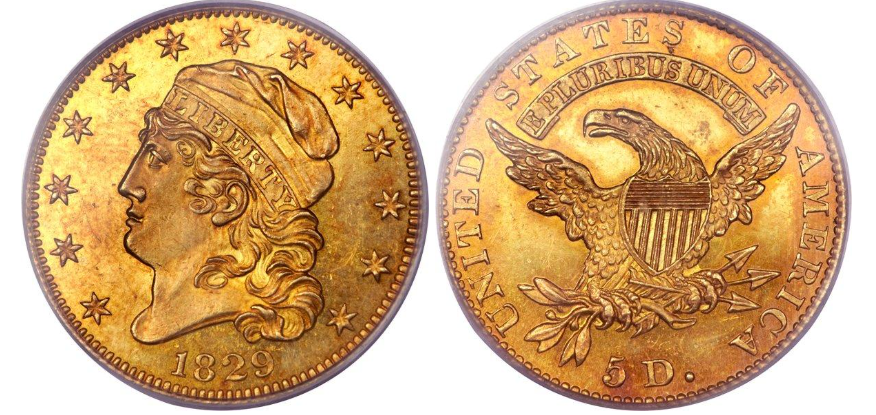
All these early coins shared one problem: the price of gold had increased on the world market, making their intrinsic gold value higher than their face value. Over a million of these half eagles were minted from 1795-1834 but most of them were melted for profit soon after they were issued. That is a major reason why they are so scarce and expensive today. It wasn’t until 1834 that Congress corrected this problem. The weight and fineness were changed, resulting in a coin struck in 90% gold alloy with a total gold content of 0.242 troy ounces. It was no longer profitable to melt the coins and so half eagles began to be widely used in circulation.
The new 1834 coins are the so-called “Classic Head” type, with a redesigned head of Liberty. The reverse was basically the same but the motto E Pluribus Unum was removed. The Classic Head half eagles are generally much less expensive than the earlier types. During their 5-year run over 2 million Classic half eagles were struck. Here are images of an example from 1838.
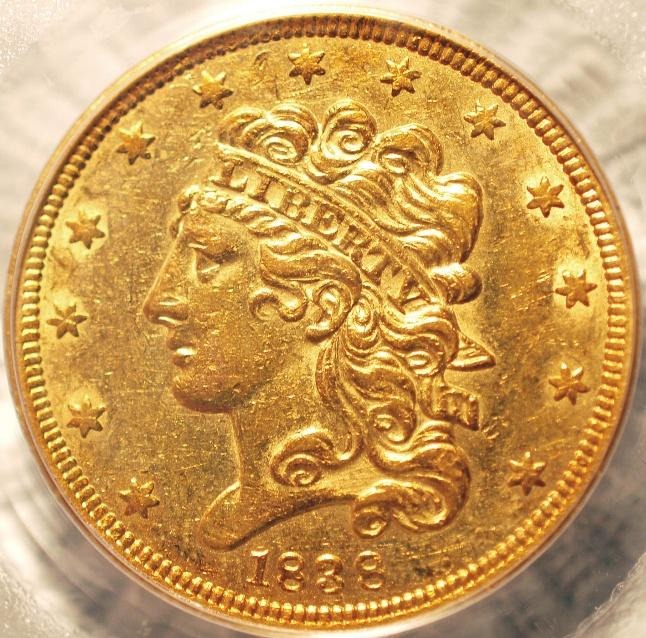
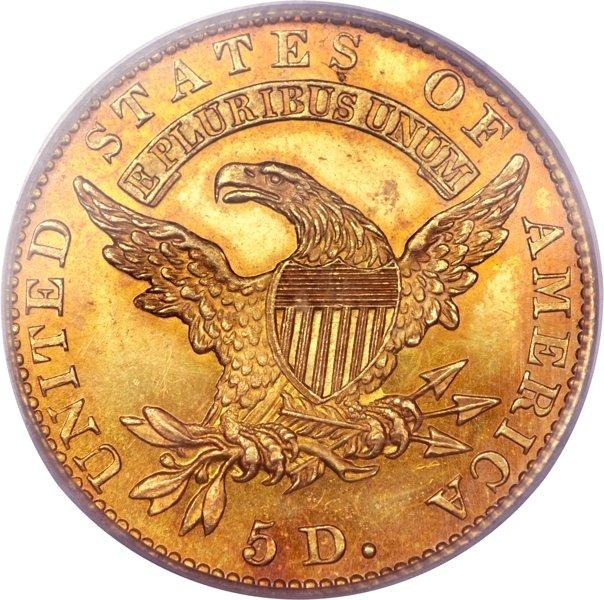
The earlier types of half eagles were all struck at the Philadelphia mint, which was the only US mint in operation from 1793 through 1837. No mintmarks appear on these coins. The Classic Head type was the first half eagle to be issued at branch mints, in 1838. Mintmarks were added above the date to indicate coins made in Charlotte, North Carolina (C) and Dahlonega, Georgia (D). The Classic design was replaced in 1839, when the Liberty Head coins designed by Christian Gobrecht were introduced. The new Liberty portrait was also adopted for the quarter eagle ($2.50) and eagle ($10) gold coins. For the half eagles the denomination text was changed from “5 D.” to “FIVE D.” Branch mint issues from the first year (1839) have mintmarks positioned above the date. From 1840 on, mintmarks were moved to the reverse, below the eagle.
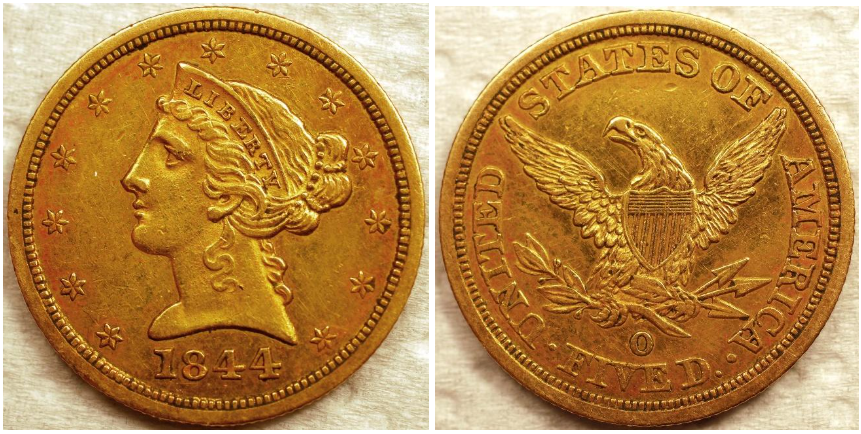
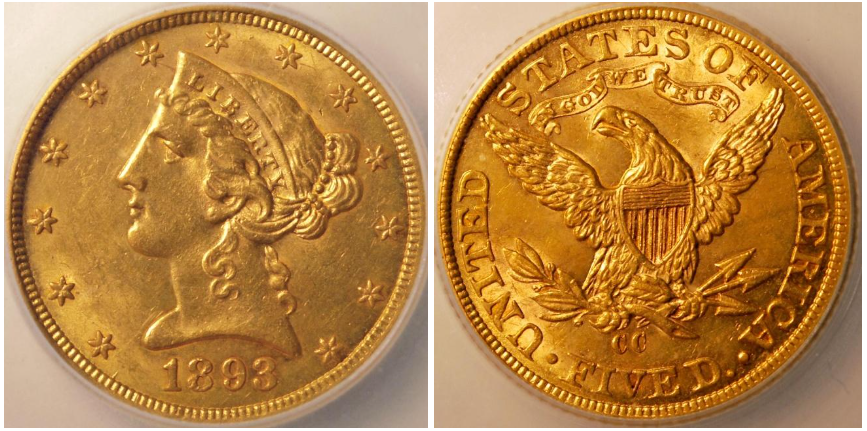
There are two major varieties of Liberty Head half eagles. The No Motto coins were struck from 1839 until mid-1866. In that year the motto IN GOD WE TRUST was added to the reverse, above the eagle. The design continued without further changes until the end of the series in 1908. Throughout their 70-year production run, Liberty Head half eagles maintained the same gold content of 0.24187 troy ounces. Many Liberty half eagles are common and in circulated grades sell for little more than the value of the gold. Here are examples of a no-motto half eagle from the New Orleans mint (1844-O) and a with-motto coin from Carson City, Nevada (1893-CC).
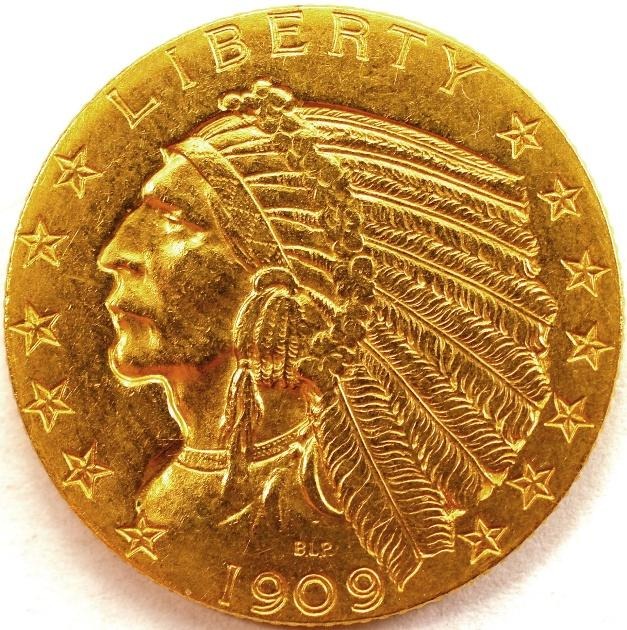
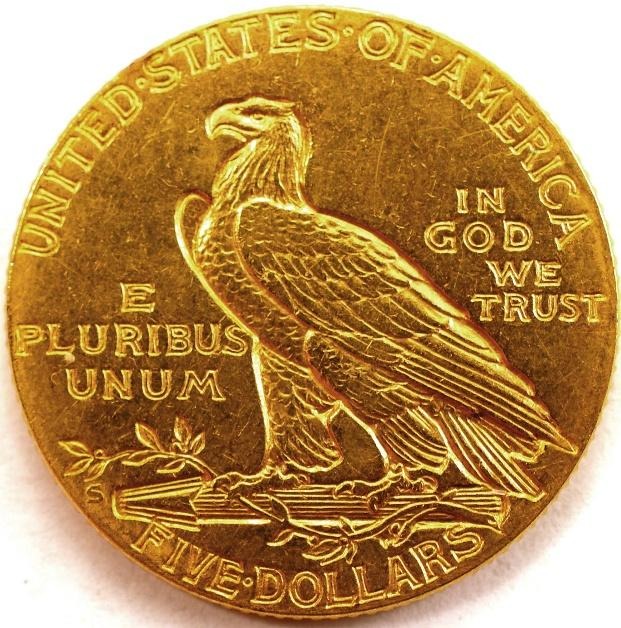
The final regular issue half eagles were of the Indian Head design. These coins feature a male Native American portrait with a full feather headdress. The reverse has a standing eagle motif, with the eagle’s claws gripping a sheaf of arrows and an olive branch. The denomination is fully spelled out as “FIVE DOLLARS”. This design was also used for the quarter eagle and is unique among United States coins in that the design on both sides is incuse, meaning the images and legends are actually recessed into the coin surfaces. These half eagles were issued from 1908 to 1916 and then brought back for a single, final year in 1929. Here is a 1909-S example, from the San Francisco mint. The mintmark is located just to the left of the arrowheads on the reverse.
Gold five-dollar coins continue to be minted as commemorative issues, beginning with the 1986 Statue of Liberty half eagle. As of this writing (November, 2026) approximately 37 different designs of commemorative half eagles have been issued. These coins are made with the same gold content as the circulating half eagles struck from 1834–1929. When you include the commems, the half eagle turns out to be the only US denomination of coin to be struck at all eight United States mint locations. Half eagles are historic, beautiful, and will always be valuable since each one contains about a quarter-ounce of gold. They are wonderful coins, well deserving of collector interest.