
The Coinage Act of 1792 specified the basic parameters of the new monetary system for the United States. The Act established the dollar as the standard unit of currency. The amount of gold or silver that would constitute one dollar of value was also defined. Copper was specified as the metal to be used to make the cent and half-cent coins, which would be valued at 1/100 and 1/200 of one dollar, respectively. This trimetallic system had been used by virtually all nations since antiquity: coins were made from gold, silver, and copper, with each coin valued in proportion to its metal content. There is however another metal which is eminently suitable for making coins, assuming appropriate techniques are available. Since this material was unknown to the ancients, its potential use in coinage was never a possibility. This situation changed in the 1700s with the discovery of Platinum.
Platinum was known to pre-Columbian natives in South America, who separated platinum granules from alluvial deposits. They were able to fashion artifacts from the metal by alloying it with gold (which lowered the melting point) and hammering it into shapes. The metal was officially discovered in the 1700s by European chemists who studied this mysterious South American material which was brought over by explorers and prospectors. Because of its high melting point, it could not be melted and cast into ingots with the technology of the time. It could however be dissolved in acids (like Aqua Regia) and experimenters were eventually able to prepare a fairly pure product. The fine powder generated by their processes (called “sponge”) could be consolidated by compressing and heating. It was perceived as having some value because it was rare, heavy, brilliant, and would not tarnish. The process was inconsistent but in Spain especially the metal was worked to form utensils, buttons, and decorative items.
In the 1820s deposits of platinum were found in the Ural Mountains in Russia. Czar Nicholas I decided his nation should try to profit from this discovery so he authorized the creation of platinum coinage. Russian scientists came up with a powder metallurgy process to make malleable platinum from the refined “sponge” that they extracted from the ore. The consolidated product was rolled into strip and punched to form planchets. The coins were made in denominations of 3, 6, and 12 roubles. Based on the relative weights of platinum and gold rouble coins the platinum was valued at approximately 40% of the value for gold. Production costs were very high compared to costs for making gold and silver coins. One contemporary report stated that the manufacturing cost to produce a single 3-rouble platinum piece was 98 kopeks, not including the platinum. The manufacturing cost for gold coins was less than 1 kopek per rouble. Another concern was that there was no way to ensure that the price of platinum would remain consistent relative to gold and that circulating platinum coins would have a “destabilizing” effect in an economy based on gold, silver, and bronze coinage.
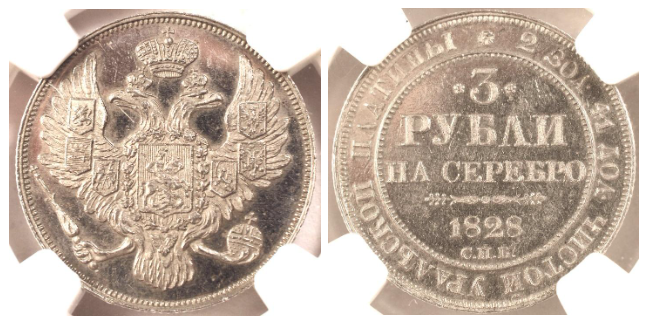
The first Russian platinum coins were minted in 1828. These 3-rouble pieces were 24mm in diameter and weighed 10.4 grams. The larger 6-rouble and 12-rouble coins were first issued in 1829 and 1830, each containing a proportional amount of platinum. The total mintage for all 3-rouble coins was 1,371,691 pieces. Total production for the larger coins was much lower: just 14,847 of the 6-rouble coins and 3,474 of the 12-rouble pieces were made. These coins all feature the imperial Russian two-headed eagle on the obverse. The reverse has the date, denomination, and legends in the Cyrillic alphabet. Mintage for all denominations was discontinued in 1845. The Russian government issued a decree that demonetized the coins and an attempt was made to recall them so they could be melted down. Of the nearly 1.4 million total platinum coins produced, only a tiny surviving population remains.
As is the case for many rare and expensive coins, only certified examples of platinum rouble coins should be considered for purchase. There are many forgeries, even counterfeits made from genuine platinum. In some cases, the fakes can be detected because the platinum is too pure. The original process used to extract the platinum from the Russian ore left traces of iron in the metal. Genuine coins contain from 1 to 4% iron. Modern testing methods like X-Ray diffraction (XRF) can help confirm the metal composition, without damaging the coin.
So, what will it take to add an authentic Russian platinum 3-rouble to a collection? Unfortunately, quite a bit of money will be required. As of 2026, certified examples in Very Fine to Extremely Fine grade seem to run from about $1200 to over $2000. If you want to stretch for an AU the price can approach $4000. An MS-63 example will likely cost a minimum of $8000. Proofs were also struck for many of the production years and these seem to cost even more than the BU examples. They are spectacular-looking coins, often with deep cameo contrast. In case an $8,000 price tag just isn’t expensive enough, you might consider the 6 and 12-rouble pieces. These can cost upwards of $100,000 for high end specimens.
Here are images of an 1828 Russia 3-Rouble coin, graded NGC MS-63 Proof-like:
The Russian experiment with circulating platinum coinage ultimately was not successful. It was however a tribute to the ingenuity of Russian technicians who developed novel processes to commercially exploit a new natural resource. The surviving examples of these historic coins are available to modern collectors and provide proof that Russia did indeed produce the world’s only circulating platinum coinage.