History and Coinage Operations of the New Orleans Mint

The New Orleans Mint in Louisiana operated from 1838 through 1861, and again from 1879 through 1909.  Coins minted in New Orleans bear the distinctive “O” mintmark and are an important focus for numismatists.  The history of the mint and details about its operations are fascinating subjects for study.  This article explores this topic and offers some specific information about the manufacturing processes employed during the mint’s years of coin production.

President Andrew Jackson was a military hero based on his decisive victory over British forces at the Battle of New Orleans, at the tail end of the War of 1812.  During his presidency he was a proponent of creating branch mints to increase the production of United States coinage.  On March 3, 1835 Jackson signed a bill authorizing the construction of three new mints, to be located at Dahlonega, Georgia, Charlotte, North Carolina, and New Orleans, Louisiana.  The Dahlonega and Charlotte mints were relatively small facilities and produced gold coins only.  Both of those mints closed at the onset of the Civil War and never reopened.  The much larger New Orleans mint produced gold and silver coins, in all denominations.  Although this facility also closed during the Civil War it reopened in 1879 and continued to manufacture gold and silver coins until 1909.

 Historical records include many contemporary references that describe in detail the production processes employed at the New Orleans Mint.  From the acquisition of the gold and silver raw material to the eventual shipment of the finished coins, the entire minting operation is a fascinating area of study.  The New Orleans mint operated in an era when coal-fired steam engines powered the equipment, horse-drawn wagons were a primary means of transportation, and electricity and the internal combustion engine were just coming into widespread use.  The Mint nevertheless developed machines and procedures that allowed the efficient production of coins on a tremendous scale.

The New Orleans mint typically received precious metal in the form of dust, ingots, foreign coins, and old jewelry.  The depositor was given a receipt and charged a fee if refining was needed to prepare the metal for coinage.  The metal was assayed and the result reported to the mint treasurer.  Once the value of the metal was determined the depositor presented his receipt and was paid in US currency.

The refined, alloyed metal was melted and cast into standard-sized ingots which were repeatedly passed through a rolling mill to create metal strip of the proper thickness.  The strips were heated and cooled (a process called annealing) as needed to keep the metal malleable.  The final thickness adjustment was made at a “drawing bench” where the strips were drawn between precisely calibrated steel cylinders.  A vertical steel punch apparatus was then used to cut out the circular coin planchets.  Each punch at maximum operating speed could turn out 225 planchets per minute.  The strip scrap remaining after planchets were punched out was returned to the furnace for re-melting.  In fact, all gold and silver scrap was carefully monitored and controlled, with very little loss.

Female employees were generally hired to sort the planchets to ensure the weights were correct.  Light planchets were returned for re-melting while heavy ones were hand-filed to correct the weights.  Approved planchets proceeded to the milling room, where they were compressed between a rotating steel wheel and a stationary wall;  this created a uniform raised rim on each planchet.  Depending on denomination, between 500 and 1200 planchets could be milled per minute.  Finished planchets were annealed, washed, and sent to the coining room.

Different coining presses were employed for different coin denominations.  Planchets were fed into brass tubes from which they were removed and placed in the coining chamber by steel feeder fingers.  The dies closed on the planchet with a force of around 150 tons of pressure to create each coin.  The feeders simultaneously grasped the finished coin and the next planchet;  the feeder motion then transferred the coin into a collection hamper and placed the planchet into the coining chamber.  The rate of coin production was generally about 85 coins per minute, per press.

Finished coins were inspected, weighed, and packaged in boxes.  The filled boxes were weighed in the presence of the treasurer.  If the weight was correct, the sealed box was placed in a vault.  Samples corresponding to each potential shipment were sent to the assay department at the Philadelphia mint for review.  If approved, each shipment was made available for coinage orders.  If samples were rejected, the affected production run was condemned and re-melted.

During its years of operation (from 1838 to 1861 and from 1879 to 1909) the New Orleans mint produced silver 3-cent pieces, half dimes, dimes, quarters, half dollars, and dollars.  With the exception of the 4-dollar Stella patterns, New Orleans produced gold coins in all denominations:  gold dollars, quarter eagles, three-dollar gold pieces, half eagles, eagles, and double eagles.  The gold and silver coins from New Orleans include many rare and valuable issues.  Among these are the extremely rare 1838-O proof half dollars, the 1856-O gold double eagle, and the unique proof 1844-O eagle and half eagle coins.  However, many more issues are common and easily within reach for the average collector.  The coinage of New Orleans is an important and popular focus for numismatists.  Every collector of United States coins should own at least one example struck at the legendary New Orleans mint. 
The True (?) Story of the 1792 Half Disme

written by James Obler

Prominent coin dealer and former ANA President Jeff Garrett wrote an interesting article about the 1792 Half Disme which was posted on the NGC website on 06/18/2020.  The article discussed the history of this special coin and reported on some new research that casts new light on its probable origin story.  This research has uncovered clear evidence that these coins were struck for general circulation and, unlike other denomination coins struck in 1792, were not patterns.  Accordingly, the newest edition of the Red Book (as of 2020) lists this coin in the regular-issue Half Dime section.  Incidentally, the word disme is an obsolete French word meaning “a tenth part”.  It is pronounced “deem”.

It is generally agreed that an attempt to develop a national coinage was made in 1792.  1,500 silver half dismes were coined by U.S. Mint employees in the basement of saw maker John Harper’s Philadelphia factory.  There are two commonly-reported legends associated with this important event.  The first is that George Washington provided his own silverware to be melted down for the production of the coins.  The second is that Martha Washington was the model for the portrait used on the coins.   Recent research as related by Mr. Garrett tells a somewhat different story.

Thomas Jefferson maintained a personal ledger of income and expenses which he called his Memorandum Book.  An entry dated July 11, 1792 reads “Delivd. 75.D at the mint to be coined” and on July 13 another entry reads “Rec’d from the mint 1500. half dismes of the new coinage”.  75 Spanish milled dollars (75.D) contain the exact amount of silver needed to make 1500 half dismes.  That same day (July 13, 1792) Jefferson left Philadelphia to begin his summer vacation at Monticello.  His Memorandum Book records that he made numerous expenditures of 5 cents or multiples of that amount on his trip.  This information constitutes strong evidence that not only was Thomas Jefferson directly involved in the production of the 1792 half dismes, he also regarded them as circulating coinage and personally used them as such.  

Another indicator of the regular-coinage status of the half disme is found in President Washington’s fourth annual message to Congress on November 6, 1792, in which Washington specifically stated that the half dismes had been made as regular coinage.  One additional relevant piece of information is that a unique example of the half disme is known that was struck in pure copper.  The existence of this piece suggests the dies were first tested using a base metal planchet, after which the production run was completed using Jefferson’s silver.  The copper example then would be the actual pattern half disme coin.

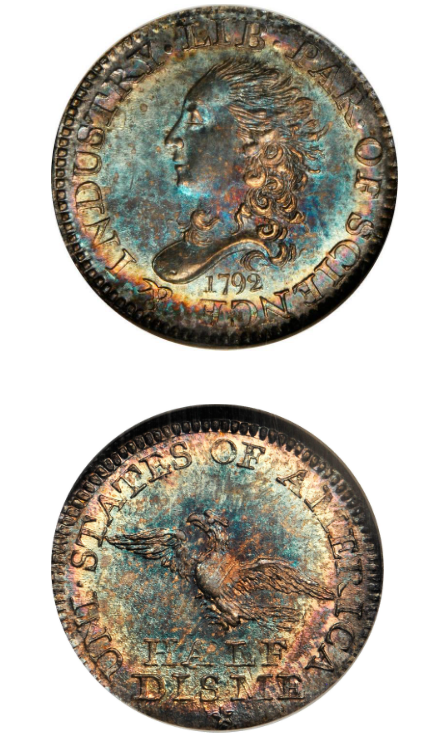
Many examples of  1792 half dismes are known in various circulated grades.  Some pieces are holed and presumably were worn as jewelry.  A few gems are known and these are among the most desirable coins in all of numismatics.   The current price record (as of 2020) is held by the finest known example, graded NGC MS-68.  This spectacular toned beauty is pedigreed to David Rittenhouse, the first director of the US Mint.  It was sold in 2018 by Classic Coin Company for $1,985,000.  That’s only 39.7 million times face value!  Here are images of this amazing coin.

Now that the true history of the half disme is known, demand for these iconic American treasures might become even more intense.  It seems likely that new record prices may be set in the future.

CategoriesCoin Article

Silver Content Analysis for Selected Ancient Coins

The first silver coins were produced around 600 BC in various locations including Lydia (in present-day Turkey) and India. The Greeks began striking silver coins before 500 BC and were likely the most prolific silver coin producers of their time. Silver coin production continued with the Romans and with practically every other empire, kingdom, and country for the following two thousand years. It’s only in the modern age that circulating silver coinage has been discontinued. While silver is obviously still a precious metal, it is no longer used to make coins for commerce.

CategoriesCoin Article

Error Coins

Often errors occur during the coin manufacturing process. Depending on the nature of the error, the resulting abnormal coin may have no significant extra value, it may carry a slight to moderate value premium to an error specialist, or it may be very valuable. This article shows examples of several types of error coins.

CategoriesCoin Article

The Silver “Owl” of Ancient Greece

The Fresno Numismatic Society hosted our annual Coin Show on October 23 and 24, 2020.  As usual, we had an excellent group of dealers who offered a great variety of coins and currency.  I spotted an exceptional coin in the display case of dealer Glen Schinke.  It is an Athens Attica silver tetradrachm from ancient Greece.  This coin is popularly known as an “owl” because of the owl figure that dominates the reverse side.  I have been aware of this coin ever since my parents picked up a brass replica piece at the New York Natural History Museum in about 1964.  It only took 56 years, but I finally have one to call my own.  Even though it’s over 2400 years old, it is extremely well-made and well-preserved.  Here are some photos of this wonderful coin.

CategoriesCoin Article

The Mints that Coined Southern Gold

Charlotte, Dahlonega, and New Orleans

The first mint in the United States was established in Philadelphia and commenced regular coining operations in 1793. Despite the best efforts of mint personnel, for many years the output of the mint was not sufficient to meet the commerce requirements of the young nation. Official US coins circulated alongside a wide variety of foreign coins, private tokens, and paper bank notes. Gold coins in particular were practically unknown in circulation, primarily because the official standard ratio of 1 ounce of gold to 15 ounces of silver undervalued the gold in comparison to the European standard. Most American gold coins were exported and melted for bullion. This problem was eventually solved by the passage of a law in 1834 that reduced the amount of gold in the coins. It was no longer profitable to melt coins for bullion so they began to be seen in circulation.

CategoriesCoin Article

The 1885-CC Morgan Dollar

As far as national events go, 1885 was a quiet year. Some noteworthy events that happened were on February 18th, when the literary classic “The Adventures of Huckleberry Finn” by Mark Twain was first published. On February 21st President Chester A. Arthur dedicated the Washington Monument. On March 4th Grover Cleveland succeeded Chester A. Arthur as President of the United States. On July 23rd, President U. S. Grant lost his final battle, dying of cancer at age 63. 1885 was also the year that President Cleveland signed off on the first closure of the Carson City Mint. Some coins were produced prior to that closure however, including the 1885 Morgan Dollar.

CategoriesCoin Article

A Brief Description of Civil War Tokens

Tokens constitute an important and popular field within numismatics and are pursued by avid collectors worldwide.  In the United States many token afficionados concentrate on Civil War tokens issued from 1862 to 1864.  There are thousands of different Civil War tokens (CWTs) known.  Some are quite common while others are extremely rare.  These tokens offer a fascinating perspective on life during the Civil War and on economics in general.