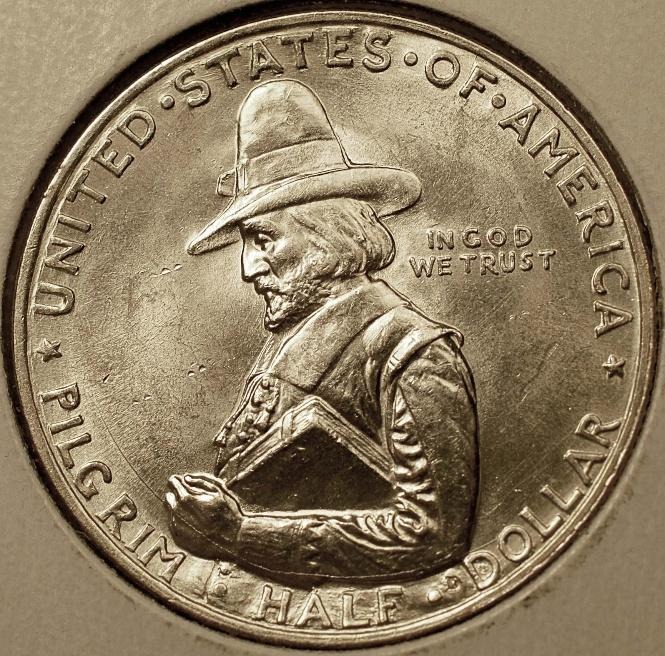
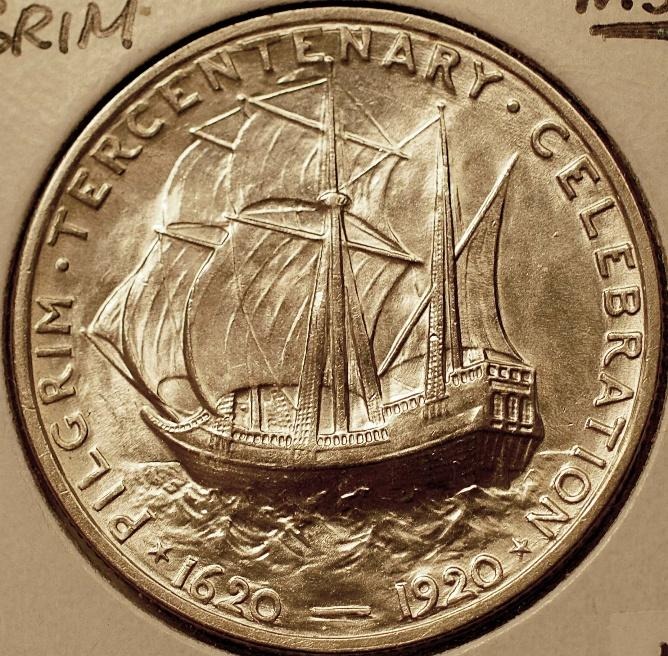
I usually buy raffle tickets at our monthly FNS raffle, both to benefit the club and to possibly win a prize. One month I got lucky and came away with the big win, a 1920 commemorative Pilgrim half dollar in nice BU grade. This coin was issued in 1920 and 1921 to mark the 300th anniversary of the Pilgrims’ arrival in North America and their founding of the Plymouth Colony. The obverse of this coin features a portrait of William Bradford, who led the Colony for 30 years. The portrait is an artistic guess since no authentic painting or image of Bradford is known. The figure holds a Bible in recognition of the religious focus of the Pilgrim expedition. The reverse shows the ship Mayflower under full sail. This coin was struck in high relief and is really quite elegant. Here are photos of that coin.
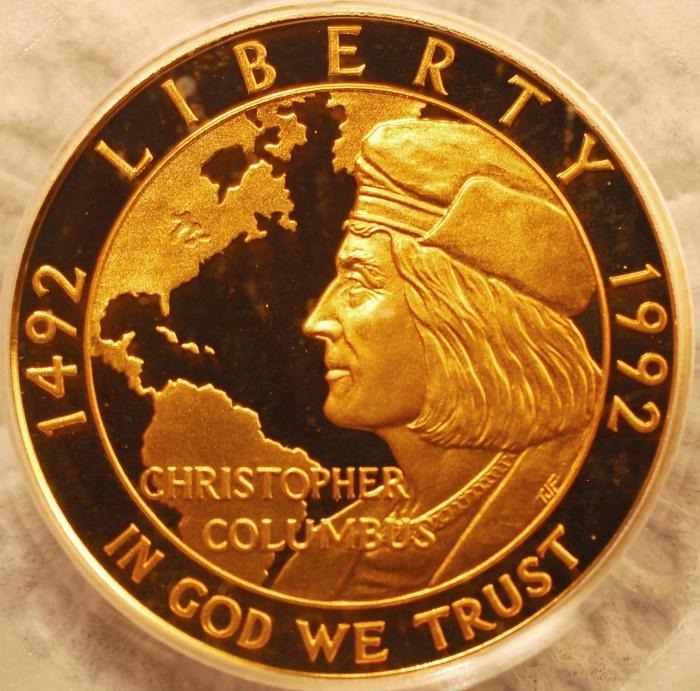
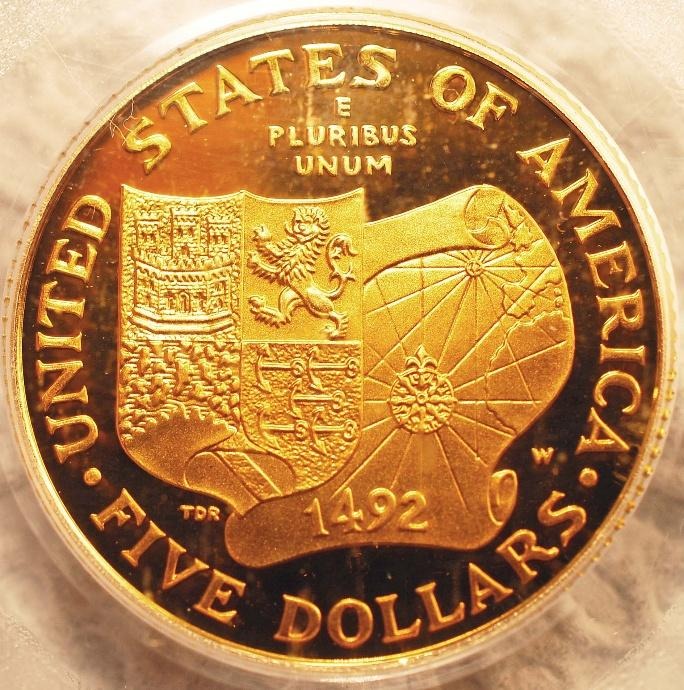
I have two other commemorative coins: an 1893 Columbian half dollar, and a 1992 Columbian 5-dollar gold piece. These coins were struck to honor the 400th and 500th anniversaries, respectively, of the landing of Christopher Columbus and his expedition in the New World. Both these coins feature creative designs which highlight the achievement of Columbus as an explorer. Here are photos of the gold coin.
So, what is the point of American commemorative coins? It seems obvious: to publicly recognize significant events and people that were important in the history of the United States, and to preserve the memory of those events for the benefit of future Americans. A quick look at the commem section of the Guide Book of United States Coins (Red Book) provides a virtual bullet point list of important events and pivotal historical figures.
Crucial battles from the American Revolution and the Civil War have been memorialized with commemorative coins. The Louisiana Purchase and the Lewis and Clark Expedition are celebrated with gold dollar coins. The opening of the Panama Canal is recognized with a silver half dollar and gold dollar and quarter-eagle coins, plus the remarkable gold 50-dollar pieces, struck on both round and octagonal planchets.
The silver half dollar is the most common format of commemorative, often used to mark important anniversaries of the founding of states, territories, and cities. Both a half dollar and a gold quarter eagle ($2.50 face value) were issued in 1926 to celebrate the sesquicentennial (150th anniversary) of the Declaration of Independence. Half dollars commemorate major expositions in San Diego, CA and Cleveland, OH, as well as the opening of the Oakland-San Francisco Bay Bridge. Famous people from American history are well represented on commemorative coins: George Washington, Abraham Lincoln, the Marquis de Lafayette, Daniel Boone, Booker T. Washington, and George Washington Carver all appear on various issues. Even the notorious P.T. Barnum has a place on a U.S. silver half dollar!
Many commemorative coin programs were operated as fund-raising efforts, to help pay for the construction of memorials, for example. Once the program organizers were granted authority to design the coins, they were struck by the US Mint and sold to the public at a premium over face value. In some cases, unsold coins were released into circulation. Collectors who diligently hunt through coin rolls occasionally report the discovery of commemoratives such as the 1923 Monroe Doctrine Centennial and 1925 Stone Mountain Memorial silver half dollars.
The so-called Classic period of US commems ran from 1892 to 1954. The Modern commem era commenced in 1982 with the issue of a 90% silver half dollar marking the 250th anniversary of the birth of George Washington. Silver dollars and gold $10 coins were issued in 1983 and 1984 to mark the Los Angeles Olympics. New commem issues have followed on a regular basis, in silver dollar, gold $5, and clad half dollar denominations. The 2000 Library of Congress commem $10 coin features a unique bimetallic planchet made of gold and platinum. There are dozens of modern issues, with more hitting the market every year. It takes a really dedicated (perhaps fanatical!) collector to assemble a complete set.
A major factor in the appeal of commemorative coins is their tangible connection with American history. In an era when some Americans appear to be ashamed of our national history, we have these commemorative coins to remind us about what many more Americans believe is important. I look at my Pilgrim half dollar and think, “hey, in 1920 people knew that the arrival of the Pilgrims in 1620 was a big deal.” Even if you aren’t a big fan of the Pilgrims, their arrival and settlement in Massachusetts was a formative event for our national story. Now, when we are entering the second quarter of the 21st Century, various critics of America and of United States policies like to single out aspects of our country which they dislike and claim, “that’s not who we are”. Well, our commemorative coinage offers a contrary opinion. The events and people honored on these coins received that honor precisely because they represent who Americans really are.