Like many collectors who started in the 1960s, I searched through pocket change as a kid. I saved any Lincoln cent dated before 1940. I could afford to save cents but cash was lacking to accumulate many higher denomination coins. Ordinary silver coins were not that big of a deal anyway, because until 1965 of course silver dimes, quarters, and halves were the only kind that existed. Regardless of denomination, it was always a thrill to find any coin with the “S” mintmark. I always associated the San Francisco pedigree with unusual value and importance. With more experience I realized many S-mint coins are quite common but they still offer a little extra appeal.
The genesis of the San Francisco Mint was the discovery of gold in the California Territory. The widely-accepted story begins with contractor James W. Marshall, who in 1848 was employed by Sutter’s Mill, a sawmill company located in the Sacramento Valley. Marshall saw some glinting gold fragments in the waterway at the mill. After realizing that he had found gold, he tried to keep a lid on the story but word rapidly leaked out. By 1849 stories worldwide reported that vast fortunes could be made overnight by prospecting for gold in California. Hordes of miners flocked to the territory and by 1850 the population had mushroomed to over 100,000. California became eligible for statehood and was indeed made a state that year.
Ironically, neither James Marshall nor Johann Sutter, the owner of Sutter’s Mill, prospered from the gold rush. Sutter’s Mill was overrun by squatters and the landowner in 1852 was forced into bankruptcy. Unemployed after the demise of the sawmill, Marshall founded a winery in Coloma, CA which later failed. He then invested in a gold mine in Kelsey, CA but the mine did not produce. Marshall fell into poverty and passed away in 1885.
Meanwhile, large amounts of gold were being extracted from the California gold fields. The previously quiet community of San Francisco was transformed into a boomtown, with businesses largely catering to the needs of the “49ers”. A severe shortage of legal tender currency rapidly developed, making financial transactions within the gold mining district very difficult. Some gold was being transported to the mints in Philadelphia, New Orleans, and even Dahlonega and Charlotte for coining, but the process was slow, expensive, and hazardous.
The need for a local mint became more and more obvious and in 1852 the federal government authorized the establishment of a new branch mint in San Francisco. Prior to authorization of the mint, a bill was passed through Congress to establish a United States Assay Office in the city. This office was originally directed to issue coins or ingots in denominations from $50 to $10,000. The applicable text in the original bill described the proposed gold products: “They are to be struck of refined gold, of uniform fineness, and with appropriate legends and devices, similar to those upon our smaller coins, with their value conspicuously marked, and the inscriptions LIBERTY and UNITED STATES OF AMERICA.”
A former watchmaker named Augustus Humbert was appointed as United States Assayer at a salary of $5,000/year. Sculptor and medalist Charles C. Wright was commissioned to engrave suitable coining dies which would travel with Humbert to California. A contract was arranged by which Humbert would work with existing gold assaying enterprise Moffat and Company. Humbert arrived in San Francisco in January, 1851 and immediately began work on his first product, an octagonal-shaped gold piece in the denomination of $50. An example of these $50 pieces was seen by a representative of the Pacific News newspaper on February 1, 1851 and production officially began on February 14. The massive $50 pieces were known as “slugs” and were generally well-received in California, especially since they were accepted for payment of customs duties. Their accurate weight and gold content were trusted. As a result, various private-issue coins were gradually displaced from circulation since their gold content was often suspect.
A persistent lack of small change remained a problem for commerce in California. Humbert and Moffat repeatedly petitioned the US Treasury Department for the authority to coin smaller gold denominations. Authorization was eventually granted and US Assay Office coins in $10 and $20 denominations were struck in 1851 and 1852. A proposed $5 issue was apparently never produced. The small-change shortage was eventually solved by the opening of the first San Francisco mint, on April 4, 1854. This new brick facility located at the intersection of Commercial and Montgomery Street cranked out over $4 million face value in gold coin during its first year, mostly in double eagle ($20), eagle ($10), and gold dollar denominations. A few quarter eagles and half eagles were also made in 1854 and these are tremendous rarities now. Three-dollar gold pieces were also struck at San Francisco, starting with the 1855-S.
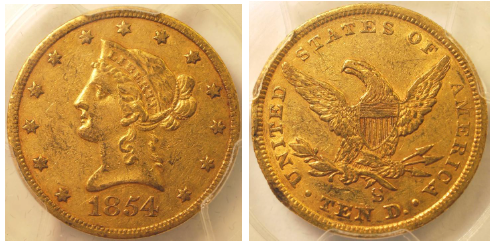
If you would like to acquire a coin made in the first year of the San Francisco mint, one option would be the 1854-S $10 gold Eagle. This coin had an original mintage of 123,826 and is one of the more available San Francisco ten-dollar gold pieces. These coins contain almost a half-ounce of pure gold and circulated examples are priced at a fairly low premium over their bullion value. This specimen is graded XF45 by the PCGS grading service. Note the prominent S mintmark located on the reverse above “TEN D.”:
Silver coin production began at the SF mint with quarters and half dollars in 1855. Both coins are popular with collectors due to their first-year San Francisco status. The first S-mint dimes were issued in 1856, when just 70,000 pieces were coined. Silver dollars debuted with the 1859-S Seated Liberty design. Trade dollars and Morgan dollars followed. Huge numbers of mint-state Morgan dollars from San Francisco have survived, with many dates being quite affordable for modern collectors. The Peace dollar was the last design for circulation dollar coins from SF. Many specimens of these Peace dollars have likewise survived.
Half dimes were first struck at San Francisco in 1863, with production continuing through 1873, the final year for the half dime. These issues include the unique 1870-S. The only known example of this date was discovered in 1978 and was initially thought to be a common type coin. This fabulous coin sold at auction in 2023 for $3,120,000; to date this is the highest price ever realized for a San Francisco coin. Silver twenty cent pieces were struck for just one year at the mint, in 1875. The first SF copper coin was the 1908-S Indian Head cent. These are popular with collectors and circulated pieces are not too expensive. The final new denomination from San Francisco is the copper-nickel five cent coin, first struck in 1912 with the Liberty Head design. This better-date nickel is relatively affordable in lower circulated grades.
The San Francisco mint was shut down in 1955 but production resumed in 1968 when both proof and circulation strikes of Lincoln cents and Jefferson nickels were issued. Cents continued to be issued for circulation through 1974. The final S-mint circulation nickels were struck in 1970. Production of proof Roosevelt dimes, Washington quarters, and Kennedy halves also began in 1968. No circulation issues for these denominations have been struck at San Francisco since the 1955 mint shutdown.
The San Francisco facility continues to operate today, with coinage largely consisting of proof coins and sets struck for collectors. Commemorative coins and bullion products are also made at the mint. Fortunately for collectors, there are millions of surviving examples of the coins minted during the classic production years from 1854 through 1955. These coins remain accessible to collectors, at all price points. Circulated, common-date SF Lincoln cents and Jefferson nickels are available for less than one dollar. Many SF silver dimes, quarters, and halves are priced at bullion value, and the common dates of SF Morgan dollars are affordable, even in choice uncirculated grade. Advanced collectors can pursue the rare dates and high-grade examples, easily spending thousands or tens of thousands of dollars for individual coins. Anyone interested in the historic issues from San Francisco has many options for building their collection.